
🔄 To read, to write, to discuss...to think!
A reflection of the reasons to read, write, and discuss, all in service of deepening our capacity to truly, unmistakably think.
A few years ago, I found myself staring at a wall.
The task before me felt important and energizing, and as with any sufficiently important and energizing project, it also felt daunting.
My co-author and I were writing the first cut of The Warrior-Scholar's Field Guide, a descriptive and conversational handbook intended to capture the core curriculum we teach at Warrior-Scholar Project on how to excel in college.
Some parts, like the section on productivity, came more naturally. I certainly made some steps in my thinking while I composed those chapters—which in a very real sense, influenced the scope and direction of this 3DProductivity blog as a whole—but I had been tinkering with those ideas for so long that it wasn't exceptionally challenging to adapt them for the field guide.
But a different section, one intended to lay out the essential WSP method on analytical reading and writing, ended up taking far more time than I anticipated.
We've long relied on this customized approach to academic reading that we refer to as "analytical reading." A core tenant since the earliest days of WSP has been to reinforce reading and writing as "reciprocal arts," channeling the wisdom in Mortimer Adler and Charles Van Doren's How to Read a Book...a 400 page on exactly that: how to read a book.
But I couldn't just write in the field guide an encouragement for folks to read so they could bolster their writing and write so they could bolster their reading, the table-stakes understanding of reciprocity. Even knowing that would be coupled with the specific steps and approach we lay out to maximize each of those disciplines, it felt inadequate. It felt like I wasn't actually capturing the essence of reading and writing and why we encourage with such zeal at Warrior-Scholar Project for veterans to take those particular tasks so seriously.
And so I stared at the wall, sipping my wine (I should note that I prefer to write in the evenings when the world is quiet and wine is acceptable) and...
And what, exactly? What was I doing in that very moment while I reread source material and notes I had taken over the years, cobbling together the chapters sentence by sentence?
I was thinking. I was taking something I had read, talked about, and even taught for years and actually distilling it into writing, deepening some neural pathways I'd been carving out for some time and creating some new pathways all together. It was the thought that propelled the whole exercise forward, not some flat regurgitation of what I'd read elsewhere. It was the thought that made the writing worthwhile.
With all due respect, it suddenly seemed to me that Adler and Van Doren had been missing something all along.
And so, I dropped my gaze from the wall, leaned forward in my chair, and scrolled up to the section's introduction, writing:
One of the essential points of college, if not the point, is to think. Einstein famously said it himself: "The value of a college education is not the learning of many facts but the training of the mind to think." When in doubt, listen to Einstein.
Yes, it’s about earning credentials necessary for your career, but we encourage students to not take such a narrow view. If you are viewing college as just a “check the box” experience, we guarantee you will not get the most out of it.
Warrior-Scholars understand that reading for class, writing essays, and participating in class is about more than just those individual actions. In everything academic you do in college, you should be thinking and learning. If you find yourself mindlessly taking notes or reading page after page without actually internalizing what you’re reading, you’re missing the opportunity to get the most out of those actions.
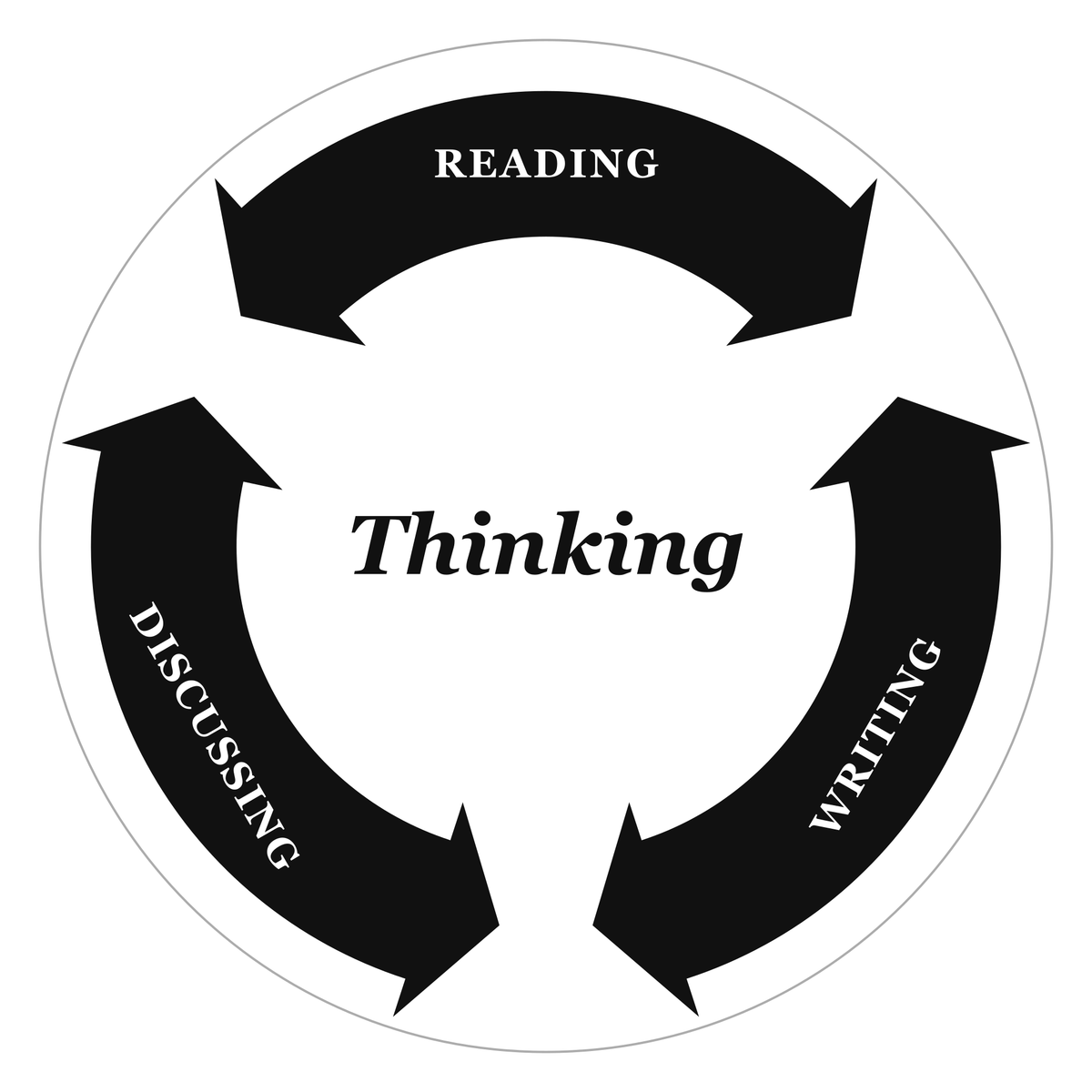
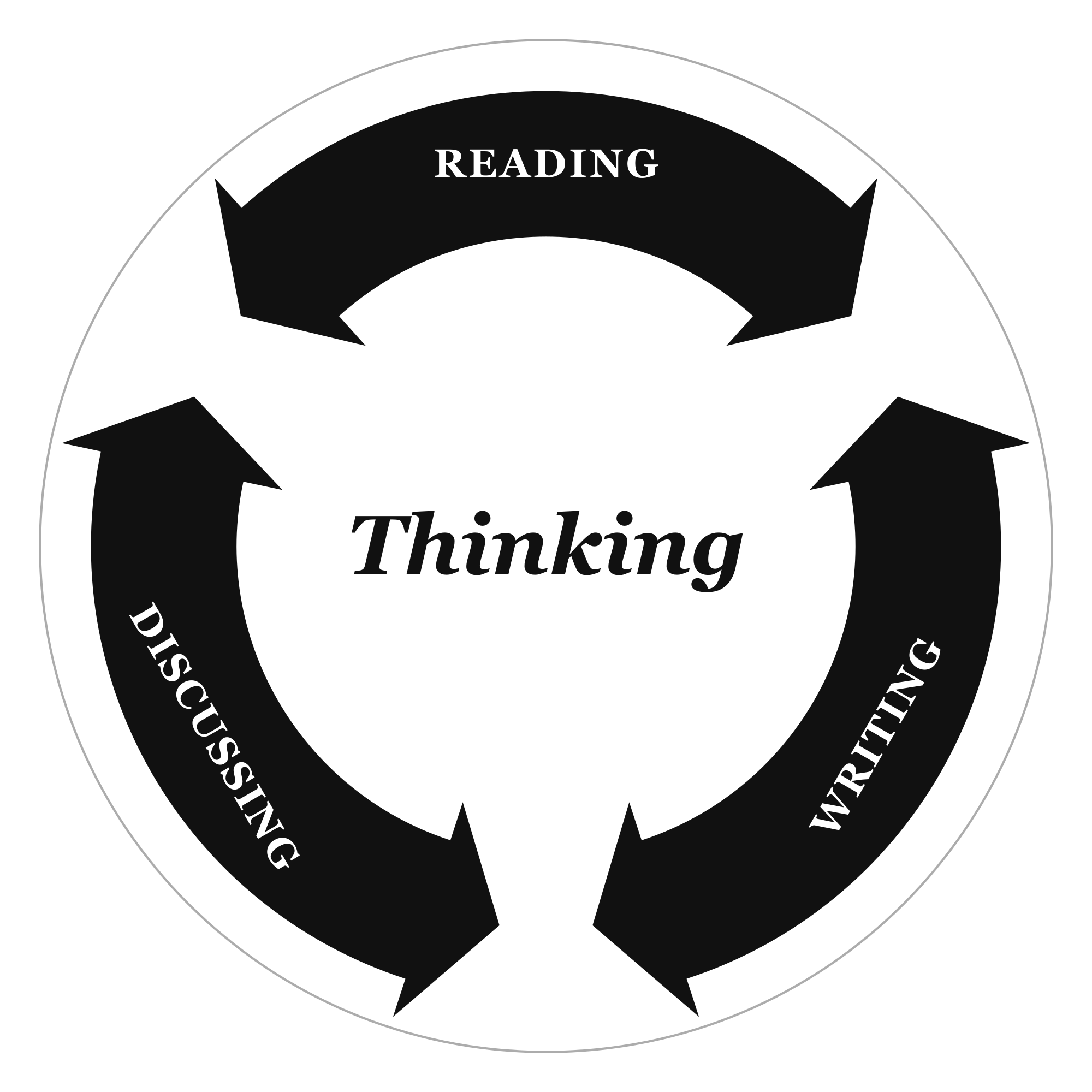
These skills aren’t just reciprocal—they are interwoven. The better your reading, the better your writing and ability to discuss. The better your writing, the better your reading and ability to discuss. The better your ability to discuss, the better your reading and writing. At the center of it all, each of these practices improves your ability to think…if done effectively.
And right above that last paragraph, I included an early version of this graphic.
I recalled my father's enduring reminders for me to think (and to never stop thinking). I channeled his lessons into my own approach, recognizing that while the thing I was producing was novel, the underlying source material fundamentally was not. I don't mean to go all we-are-but-stardust here, but it's worth remembering that everything we are is built upon everything that has been.
My thoughts are inexhaustibly influenced by the thoughts of others, and I take seriously the challenge of regularly thinking out loud that others may also be encouraged to do their version of the same.
--
This field guide has now been read by 600 some-odd enlisted veterans. This summer, the updated version will be read and discussed by over 350 more, pushing it closer to its thousandth consumer. When we seek and achieve wide publication, I hope to preserve these underlying lessons mentioned here, building a chain of folks who are evermore inclined to read, write, and discuss with such intention that they cannot help but think.
And to you, dear reader: are you thinking? Are you taking these words into your own headspace, considering what they mean and how they might impact you? Might you even consider writing down your reflections of the next thing you read, or perhaps discussing it with a friend? I can guarantee you that the experience will be all the richer if you do.
Yours, Contemplatively,
Rye