
⏩︎ Life is (Too) Fast
In world where things move ever faster, intentional slowness helps get more done and deepens appreciation for the world swirling around us.
This is the start of a mini-series I'm calling "Life is..." The thread connecting the posts, all topics I've been noodling on in draft form for quite some time, will weave together as the series progresses.
To start, allow me to share a couple appliance related tips.
First, did you know that one of the ways to make your dishwasher more effective is to run the tap until it's piping hot before you start the machine? YouTube knows I like to fall asleep to strange media, and it wasn't wrong when it fed me this very detailed and insightful video on dishwashing best practices. In essence, dishwashers pull cycles of water from the same pipes as your sink, and if you don't run the tap hot first, the first "hot" cycle will actually just be the cold water that had been sitting in the pipes. You're welcome!
On Skittering and Slowing Down
That tip has essentially nothing to do with the theme of this post, except that it's an appliance, as is the item that's actually relevant here: the vacuum cleaner.
David Cain, author of the excellent blog Raptitude, wrote a rather obvious but important point about those magnificent devices:
If you pass the vacuum head too quickly, you miss half the dirt. Slow down, and you can hear how much more grit is sent skittering up the tube. The suction and bristles are working, but they need more time to do their work fully, to draw up the deeper-lying stuff.
And oh how satisfying it is when you hear those bristles working! A bonus points to David for use of the word skittering.
More than just a celebration of the vacuum cleaner, his post walked through the values of slowing way down. Taking it to a bit of an extreme, he relayed his ongoing experiment of reading Lord of the Rings aloud, savoring each sentence and finding new meaning in the words. He makes the the excellent point "that in so much of what we do, we could be getting much more of the part of it that we really seek — but it’s only available at slower speeds."
I'm reminded of a mantra I learned in the Marine Corps: slow is smooth, and smooth is fast. Whenever I find myself making silly mistakes because I'm rushing, making more work for myself along the way because I have to correct what I've messed up, I return to that simple piece of wisdom.
Hard Isn't Bad, it's Just...Hard
We seem to have a collective obsession with accomplishing things as quickly and easily as possible, often failing to distinguish between what should be accomplished quickly and what should not. We play things on 1.5 or 2x. We favor summaries over the full text. We flit away on short-form content at the expense of the denser material that would take more concentration to unpack.
I can flit with the best of them, even dabbling in the creation of some short-form content of my own, so I don't say this judgmentally.
But I am saying that the temptation to live a frictionless life is very real and very problematic. I am on the record (does it count as on the record if posted on one's own blog?) as a stubborn advocate for the struggle. We grow and learn when we try and fail and then try again. That's how we deepen our cognitive grooves and reinforce the right neural pathways.
The writer Robert Rubsam published a compelling piece recently on the value of working, slowly, through especially hard books. "Great literature," he writes, "is an active pursuit. It enlists the reader in the act of co-creation and meaning-making." Contrast this to AI writings, which "are limited by the prompts used to create them and will always reflect the reader-prompter’s existing desires and prejudices, as well as those of the training materials, rather than prodding them to expand."
Robsam argues that "great writing remains as capable as ever of breaking open your sense of the world and your place in it."
Prolific YouTuber and author John Green would seem to agree, penning in the opening to his terrific The Anthropocene Reviewed:
It has taken me all my life up to now to fall in love with the world, but I've started to feel it the last couple of years...to fall in love with the world is to look up at the night sky and feel your mind swim before the beauty and the distance of the stars...We all know how loving ends. But I want to fall in love with the world anyway, to let it crack me open. I want to feel what there is to feel while I am here.
Same, John. Same.
Expanding My Sense of this World
But breaking open your sense of the world can be hard! Much easier to stay inside the safe bubble you and the algorithms co-create, with bite sized nuggets that satisfy but never satiate.
I'd share the link if I could find it, but I remember viscerally watching an Instagram reel that challenged the viewer to recall the topic of the video they watched before the last one. I failed that challenge, which was the point. I was scrolling so absentmindedly and consuming so unintentionally that I couldn't recall what I had seen not 60 seconds before...
In the Year of Focus, my theme for 2026, that simply won't do. I'm not going to avoid social media, as it provides genuine value and entertainment, but I do want to interrogate my usage of it.
I am certainly not going to start posting lengthy videos of me just being bored, which is apparently a TikTok trend. I am all for embracing and facilitating periods of genuine boredom—I encourage student veterans to do exactly that in the attention and time management chapter of the college success curriculum we use at Warrior-Scholar Project—but performative boredom is, at best, misguided and, at worst, deeply asinine.
I want to rebuild some grooves and habits that foster growth and do genuinely challenge and expand my sense of the world. Perhaps—perhaps—this will finally be the year I finish Infinite Jest.
I also intend to make more room for silence, or at least for music that moves me, steering away from the life of podcasts from sunup to sundown. As Thomas Chatterton Williams bluntly put it, "Maybe don’t fill every available silence with the sound of people talking."
--
Life is too fast. Its pace is only increasing, with this hungry world commoditizing attention like never before. But there is another way, if we deliberately slow down and work (and play!) with intention, not unlike that skittering vacuum cleaner.
It is no accident that I found the space and time to write this longer post while in a place that allowed it to me. While I did not plan on spending the first week of the year in Arizona helping care for my mother (a tenacious fighter, to be sure!), I was able to seize upon those circumstances and think and reflect and write from "The Wash." It's a tranquil and quiet, quiet place that helps one find their center.
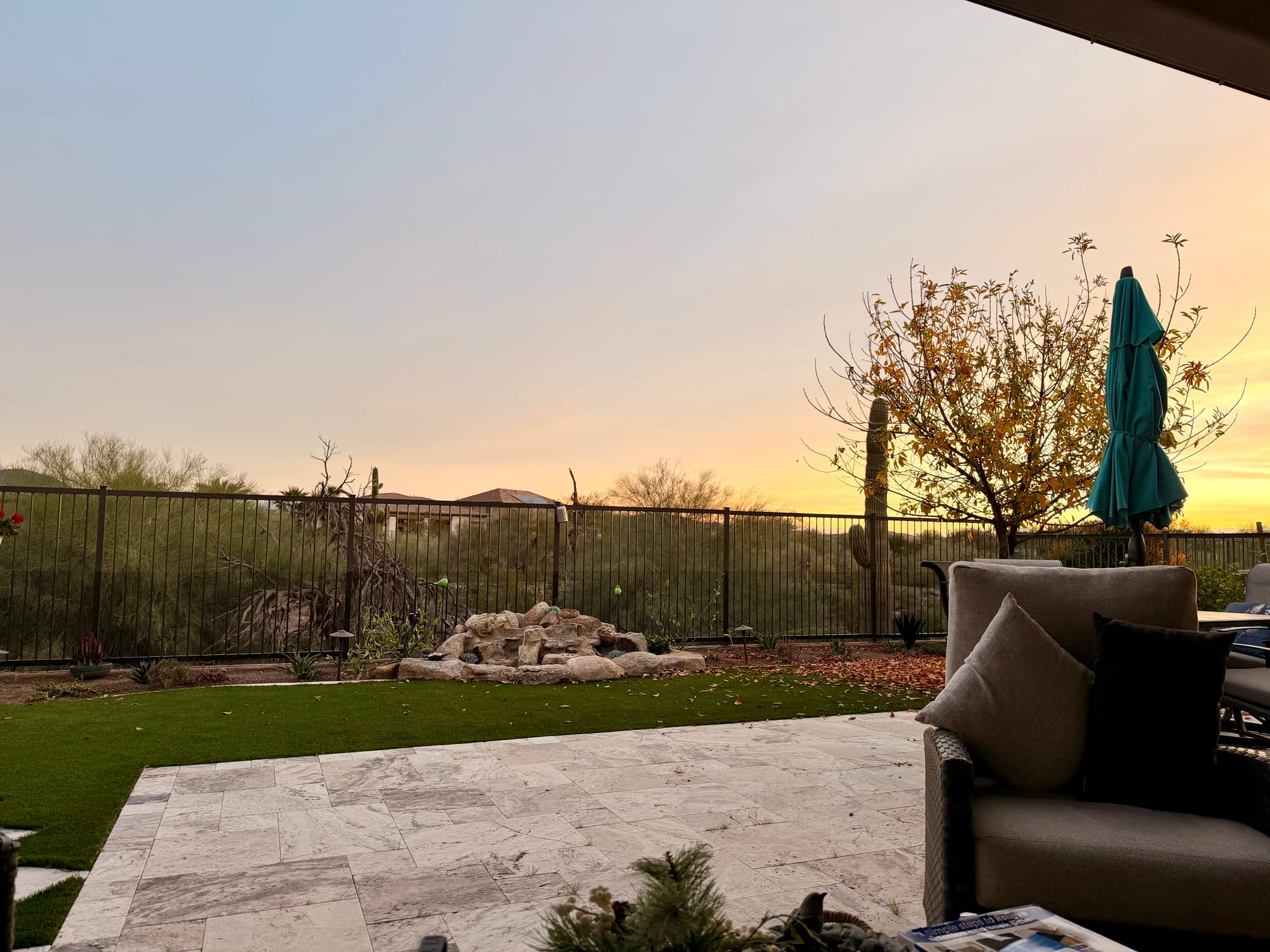
It was there that I found and read the Rubsam essay I cited above. There, he opines, "I want my sensibility widened, not pandered to." This is a worthy ambition, and in this Year of Focus, I strive to do just that.
Widen some sensibilities with me, won't you, dear reader?
Performatively Yours,
Rye
p.s. Ya know, since I wrote about the satisfaction of highly effective vacuum cleaning, I feel compelled to share this reel about the satisfaction of clean counters (language warning). If you get it, you get it.