
🧬 Life is Procedurally Generated
The world around us is constantly being generated in response to conditions outside our control. Plan and act accordingly.
Update: You can now support my work! If you derive value from what I've written over the years, please consider:
- Subscribing for free, which helps me understand my audience
- Subscribing at the $5 x month "Americano Tier"
- Subscribing at the $10 x month "Chipotle Tier," which not only helps me cover costs to run the blog but also grants access to The Fourth Dimension, an experimental portal where I'll be adding videos and articles on specific tools and techniques you can apply to more effectively manage attention and time
Last week, I launched a miniseries called "Life is..." The first entry concerned time, specifically the fact that it moves too fast by default, and that unless we deliberately try and slow ourselves down, we are in for a rough go of things.
While I found myself in that last entry discussing appliances (it turns out there's much to learn from the basic functions of a vacuum cleaner), this week, let's consider video games.
Procedurally Generating the Imaginary Sky
No Man's Sky was supposed to be a sensation. The hype around it was astounding, and even casual observers of the gaming world like me were aware of its launch. It made some bold claims out of the gate, claiming that it would be the single largest video game in history.
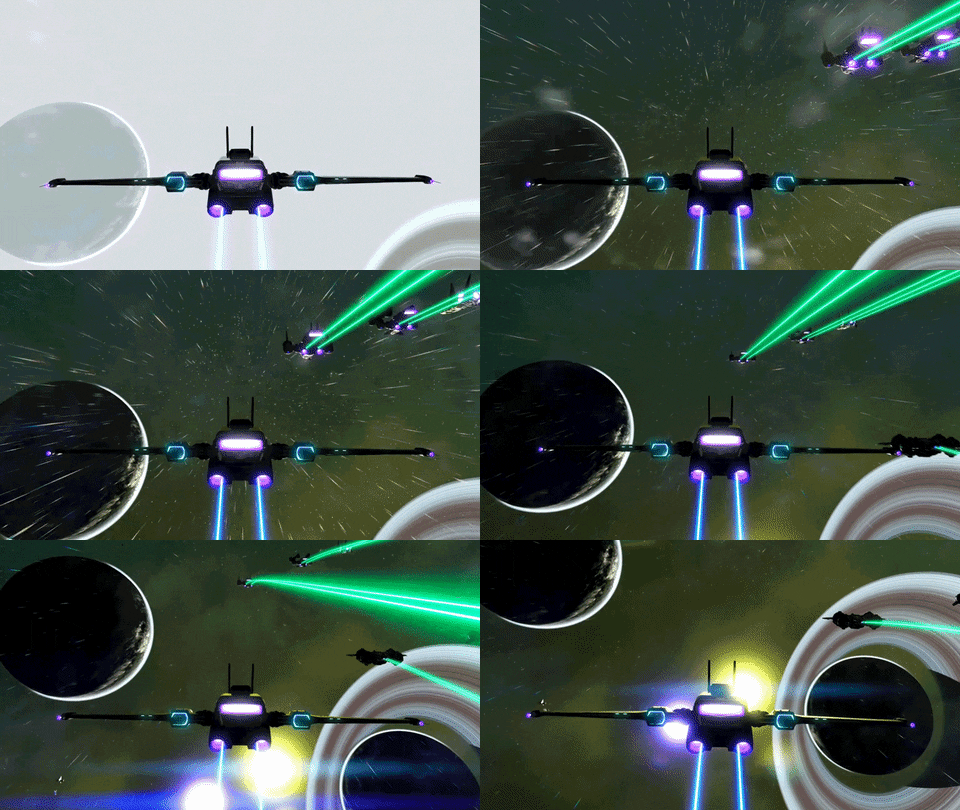
The core demonstration of its size was the number of planets the game would contain that you could travel to and walk around on: 18 quintillion. That is a lot of space rock.
But of course, no one was going to manually code 18,000,000,000,000,000,000 planets. Instead, they relied on procedural generation, "a method of creating data algorithmically as opposed to manually, typically through a combination of human-generated content and algorithms coupled with computer-generated randomness and processing power."
With this tool, the creators of No Man's Sky could provide inputs, build some algorithms, and then press "go" to draft up an absurd amount of unique(ish) planets for future users to engage with. Then, each player could travel to seemingly infinite destinations, and every single planet they'd land on would have its own features. A cosmic playground of endless things to explore—at least in theory.
Procedurally Generated Our Weather
No, this isn't going to turn into an argument that we're all living in a simulation (but, I mean, maybe?). But let's consider how the concept of procedural generation can help us navigate this particular piece of space rock we inhabit.
Life is, in a sense, procedurally generated. There's a set of rules and conditions that govern how things operate, but every day—indeed, every moment—is different. Even when things seem predictable, the influence of countless factors limits us from truly knowing what's going to happen next.
Consider the iconically dreary small talk conversation: weather. We turn to this topic because it's relatable and dynamic. It's not just that we all experience weather, it's that its constantly changing and influencing our lives. If every day had the exact same temperature, precipitation, etc. for every single person no matter where they were located, it would cease to be a topic of conversation.
I mean, I guess in that scenario, every aspect of our global ecosystem would screech to a halt and it would literally be the only thing folks talked about, but you take my point.
And if weather was so random that we experienced insane fluctuations from day to day, the planet would be uninhabitable. We need a pattern that's recognizable and a system that responds to basic laws of physics.
Combined, we can say that it's the ever-changing-only-somewhat-predictable-yet-bound-by-physics nature of weather that makes it worth talking about.

That relative unpredictability can be frustrating, but also energizing. The fact that every day is unique, weather and otherwise, can lift us up, if we let it.
Procedurally Generating Productivity
Now let's talk about you, dear reader. I hate it break it to you, but you're a mess.
The good news is that you're in terrific company, as we're all messy. And the people who appear to have it all figured out? They, I suspect, are the messiest of all.
The other good news is that it's not entirely your fault. You're a mess in part because of the relative unpredictability of the world. You can plan and optimize all you want, but the world is going to continue procedurally generating based on factors well outside your control, and all you can really do is prepare to respond accordingly.
That Mike Tyson quote comes to mind: "Everyone has a plan until they get punched in the face." He actually said "...until they get hit for the first time," but that warped a bit over time. I guess punches land harder than hits.
Even if you're in a position of influence, there's no way to predict, let alone completely control, the actions of others. You will get punched, in a sense, day after day by the world and people around you. The actions of others might be destructive or they may be helpful, but they will have some type of impact on you.
The lesson here is to not to bury your head in the sand and whine about wanting more stability. Rather, the lesson is to acknowledge the myriad things outside your control and to build in space for flexibility in your plans wherever possible. The cosmos will continue generating based on a series of set conditions, whether you like it or not.
What matters is how you engage with what's generated and whether you let it fester as frustration or seize it as opportunity.
In his latest book, General Stan McChrystal writes,
Character, the appropriate destination of our life’s journey, is not a trait inherited at birth or a gift from a learned mentor. It does not automatically come from education, position, or experience. Character, instead, is a choice. It is built upon the convictions, or deeply held beliefs, that we embrace and the discipline we muster to live up to them.
No matter the generation, character is a choice.
Procedurally Generating...Oatmeal
When No Man's Sky finally arrived, so to do its problems. Chief among them was an issue that, in hindsight, felt like it should have been obvious. It turns out that when you're creating 18 quintillion "unique" planets based on a relatively limited set of available inputs, there's a darn good chance things are going to start to look more or less the same once you've seen enough planets.
A fellow game designer referred to this as "the 10,000 bowls of oatmeal problem," meaning that if someone generated 10,000 "unique" bowls of oatmeal where every single oat was positioned differently in each bowl, the oatmeal taster would taste the same thing no matter which bowl they spooned from.

I see an application here back to the productivity angle. If you don't push yourself to experience the unique qualities and experiences of this world, it may well be that you find yourself tasting nothing but plain oatmeal. That there are functionally infinite destinations to travel, books to read, conversations to be had, or skills to learn matters not a whit if you don't reach out to experiment beyond the confines of your comfort zone.
--
There's a whole lot of life being generated around you. Perhaps its time to seek some of it out and to make a piece of it your own.
Procedurally Yours,
Rye
p.s. No Man's Sky did end up getting a lot better as the developers incorporated feedback and made substantial changes. I've only logged a few hours, but I know folks who are well into the 100+ hour mark of gameplay. There's probably a lesson or two in there about responding to successfully to criticism, so perhaps this isn't the last time you'll see me writing about this particular game.