
🫨 "Coding" for the Rest of Us
To move forward a project I've had in mind for quite some time, I spent an hour with Claude Code. It will not be my last.

I am no coder, nor a programmer, but I did something yesterday that made me feel like one. Or at least the outer shell of one. It was compelling enough that I'm taking a brief break from my "life is" blog series to share the experience.
AI is, in many ways, inescapable. That isn't to say that I think it is or should be everywhere—I'd argue it's in a heck of a lot of places it shouldn't be—but it is to say that AI is already demonstrably present in many systems we interact with, sometimes overtly and others completely beneath the surface.
Sometimes it appears in places we wish it wouldn't. I'm mindful of the frustrations relayed by a senior software engineering friend of mine at a substantial tech company, where AI coding tools were rolled out for the entire organization. The result was as frustrating as it was foreseeable: an unstoppable flood of sloppy work, where junior engineers weren't taking the time to understand what the heck they were actually doing. That's, uh, not great.
My path has taken some winding turns, but, unlike those software engineers, I don't ever see myself needing to understand intricacies of code. I've read enough in the tech world to have a healthy appreciation for those who do have that understanding, and I never assumed I'd have a tool at my fingertips that would allow me to take more direct control over manipulating the technical language behind the websites and applications I use.
But then, Claude Code.
In essence, Claude Code is a tool that allows programming illiterate people like myself to just make stuff. With a tad of setup, which is user-friendly enough for folks with basic technical competencies, you find yourself in a terminal window with a blinking cursor where you can write things like, "make me a basic website with a pixelated design that I can use to highlight projects I'm working on, social media handles, and articles I've written." Which may or may not have been my opening prompt yesterday.
The tool then "thinks" for a little while (I find it problematic that we anthropomorphize AI by using these types of verbs, but that's the common lingo these days), asks some follow-up questions, and then just... creates the thing you told it to create.
I spent about an hour going back and forth with these prompts yesterday to create ryanpavel.com. The process brought to life something which I've been considering making for quite some time, but just hadn't actually done so. I was holding off in large part because of the amount of time it would take to make it, so once that barrier came crashing down thanks to the tool, voila: the sit was born.
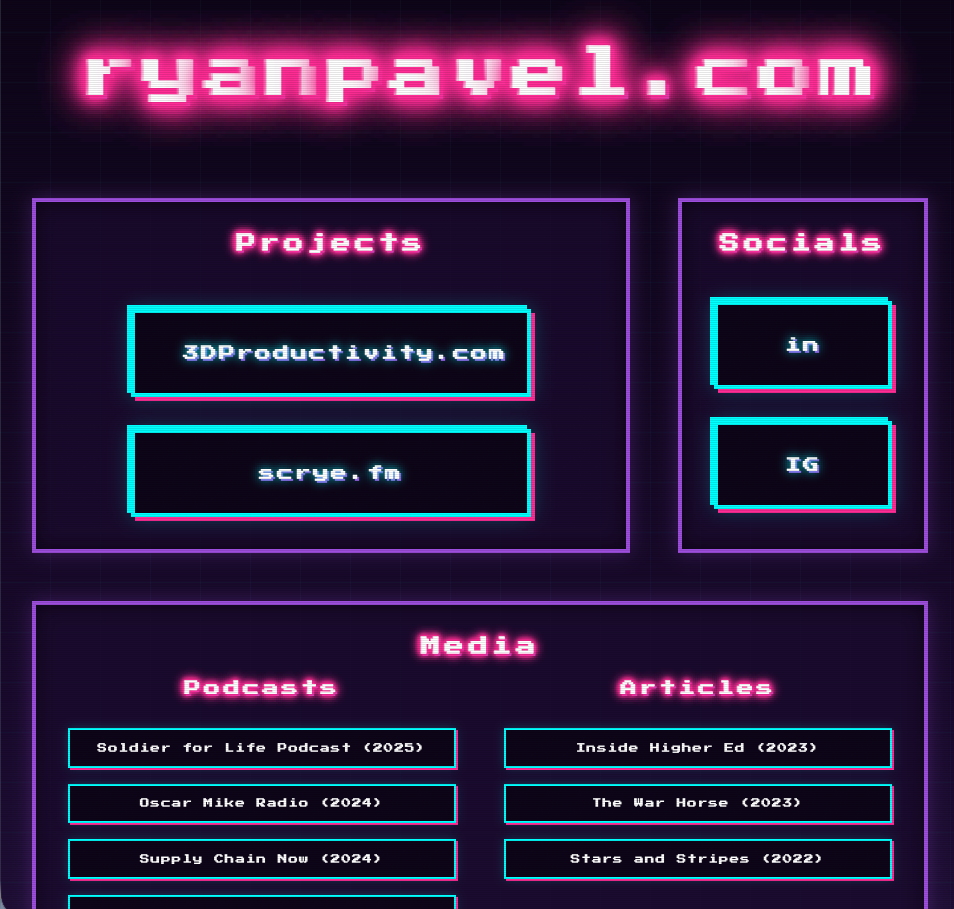
To be honest, most of that hour was about tweaking things that I thought could be cool, like having a little car driving from left to right at the bottom of the screen, or the title at the top, including a rolling animation when you hover over it. If I wanted to strip this down to the studs, I honestly could have gone from ideation to actually getting this up on a website in 10 minutes or less.

If you look at the underlying HTML code, most of it's complete gibberish to me. I could figure it out if I really had to, but the point is that not only did I not have to, I didn't have to rely on some sort of template website builder with limited design capabilities and options to get there. I just... talked to my computer for a little while.
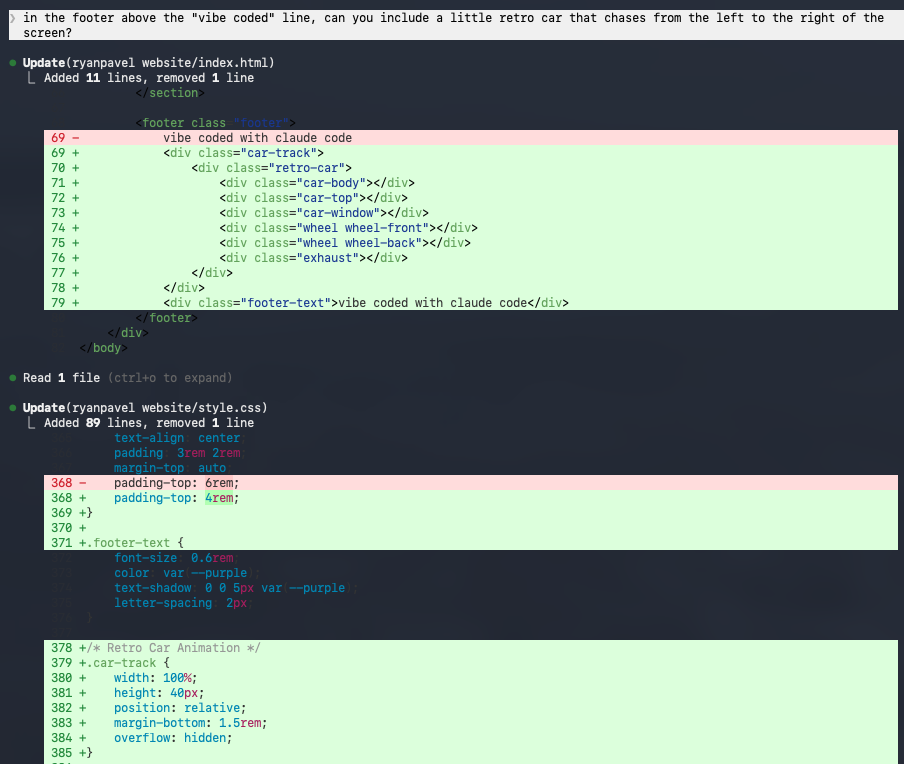
So this is the "vibe coding" everyone is talking about, eh? Take an idea, put together some loosely designed instructions, and let the AI tool channel your vibes and into a workable end product. I must admit that this process was far more intuitive than I anticipated, and that I find this intuitive nature both exciting and frightening.
If you have any appreciation for how my brain works, you might not be surprised to see what this immediately got me thinking about. No only do I have many ideas on how to refine and build out my new homepage, I could imagine vibe coding any number of cool little teaching tools to demonstrate some of the productivity concepts I teach on. I could also imagine a more technical project of creating my own version of the dictation software that I rely on all day, every day. I could see some interesting animations and outputs to help demonstrate things like the impact of the organization that I help lead, which could help convey our messaging in novel and compelling ways.
Critically, I wouldn't have to learn a ton more about the underlying code to get to any of these places. I may want to learn more, and indeed, I think that's a likely outcome, but I don't have to.
I am an AI skeptic, someone who uses it regularly for very discrete purposes, but also deliberately walls off some of the more typical usages, like having it write on my behalf (well, other than code). There are existential risks to the pace of AI adoption we are barreling towards right now as a society. But I also think it's important to identify the use cases that actually are, well, useful.
This skeptic, for one, is now confusingly willing to admit it: the vibes are real, man. We shall see where this goes.
Yours in Pixelated Retro Design,
Rye